
 Company
  Team
Team  Local Government Partners
  Case Study
 Company News
  Team Member Spotlight
  Managed IT Services
 Co-Managed
  Managed AI Services
 Managed Security Services
  Co-Managed Security Services
  Data Backup + Disaster Recovery
  Compliance as a Service
  SharePoint
 Power BI
 Web Design + Hosting
 Application Development
 Businesses
  Municipalities
  Local Government Services
  Healthcare
 Manufacturing
 Aerospace and Defense
 Guides
 News
News Events
 Municipalities
 Healthcare
 Managed IT Services
 Compliance
 Cybersecurity
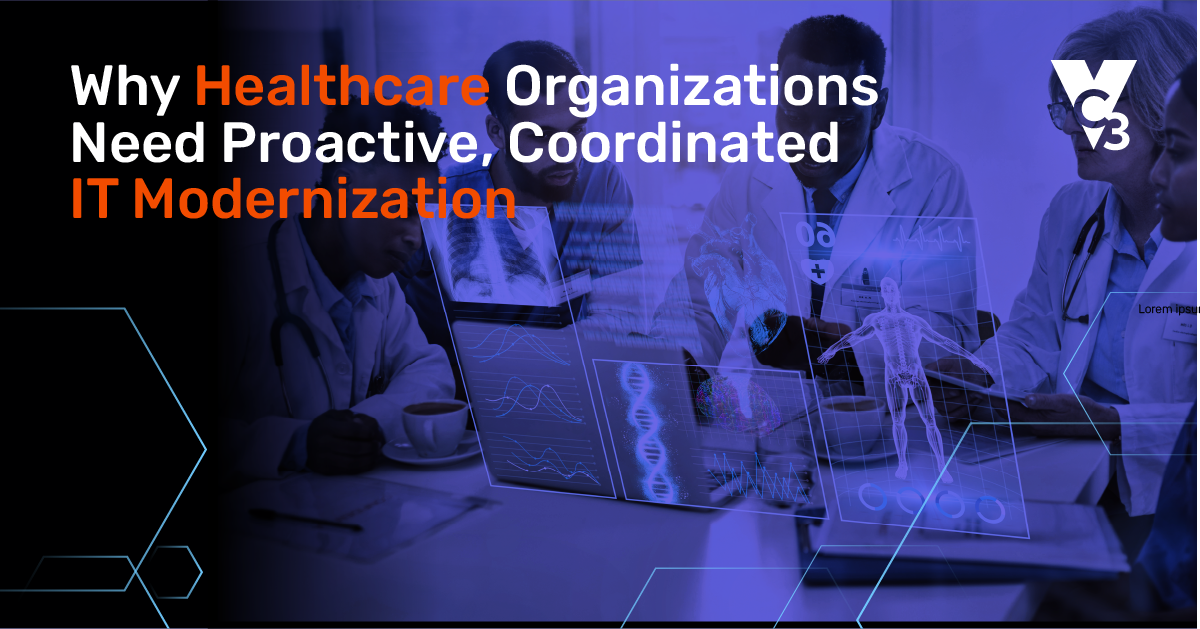
As healthcare IT environments grow more complex, they become harder to manage. More connected devices, patient data, and vendors have led to dynamic ecosystems with multiple servers, endpoints, network infrastructure assets, and applications to track.
It doesn’t help when these environments have not modernized in a long time—adding disruption, downtime, and security vulnerabilities to the mix. Managing such an environment can feel like you’re barely hanging on or set up to fail.
The stakes are high, though. The quality of patient care. Your ability to meet HIPAA requirements. Avoiding a ransomware attack. In this sense, IT modernization is not optional.
We’ve talked to many healthcare organizations over the past year, and this is what we’re hearing most about their IT pains.
1. Struggles to keep up with patch management.
Patching requires proactivity to ensure that known security vulnerabilities are not exploited by cyberattackers. Yet, many healthcare IT teams are unable to keep up on patching—especially with ever-increasing numbers of devices—when they are primarily fighting fires.
2. Outdated server infrastructure.
Server infrastructure that is end of life (such as Windows servers or application servers) opens healthcare organizations up to security risks, compliance gaps, downtime, and operational disruption.
3. Delays in rolling out uniform technology.
It’s frustrating when you’ve decided to roll out something like Windows 11 across your organization, having justified the project and budget, and you experience delays from legacy applications, hardware limitations, and integration complexity from multiple vendors and systems.
4. Fragmented systems.
Healthcare organizations have EHR platforms that don’t talk to specialty systems (such as radiology systems). Different departments use separate authentication methods. Proprietary medical devices may not integrate with centralized monitoring or patch management tools. Inefficiencies and vulnerabilities result.
5. Authentication and access issues.
Recurring problems with password management, MFA (or no MFA), and VPNs can disrupt patient care, decrease productivity, affect morale, and unintentionally force employees to use workarounds that compromise security.
6. Ongoing and/or recent security incidents.
Many healthcare organizations have experienced cyberattacks and security incidents that require a lot of time to remediate. This situation is often reactive due to a lack of proactive cybersecurity measures in place. End of life legacy servers and applications also increase the chance of an incident.
The Goal: Proactive, Coordinated IT Management in a Modernized Environment
A reactive IT environment forces healthcare teams to focus on emergencies instead of prevention. This creates a cycle of inefficiency, burnout, and growing security exposure. The longer you remain in a reactive IT mindset, the more costly and disruptive the consequences.
In such an environment, you’re only focused on the urgent and the now. You’re barely keeping the ship afloat. And you’re neglecting important proactive monitoring, maintenance, and management tasks that will end up preventing many of the problems you’re fighting every day. When compounded with an environment that relies too much on legacy systems and manual processes, it’s easy to see why healthcare IT teams are frustrated and held back.
A proactive, coordinated IT approach—supported by modern infrastructure and automated processes—helps healthcare organizations reduce downtime, eliminate recurring issues, strengthen cybersecurity, and improve clinical operations.
We know you can’t solve all your problems at once, so here are five areas where your investment of time and dollars will have the biggest impact.
- Centralize your patch management and proactively patch: It’s critical that you fix your patch management processes ASAP. Cyberattackers see organizations as easy targets when they allow known vulnerabilities to go unpatched. Implement a centralized patch management solution to automate updates across servers, endpoints, and medical devices. This will reduce security vulnerabilities, ensure compliance, and free your team from manual patching.
- Refresh your infrastructure: We realize this is easier said than done—especially if you’ve put it off for a long time. However, end-of-life servers and endpoint devices are going to hurt you more the longer you keep them. Create a plan to upgrade your servers and endpoints to current standards. Many EHR systems are now cloud-based, lessening the need for on-premises infrastructure in healthcare organizations. To maximize your investment and follow the trends of other technology in the healthcare industry, consider moving toward cloud-based or hybrid infrastructure to help lower the costs of hardware maintenance, ensure scalability, and improve disaster recovery.
- Unify authentication: Leverage a tool such as Microsoft Entra ID to implement single sign-on (SSO) and MFA across your environment. Taking this step will simplify access for clinicians while reducing the risk of credential-based attacks.
- Implement continuous security monitoring: Whether you do it in-house or find a third party (such as an MSP or a co-managed IT partner), it’s essential to have a 24/7 security team continuously monitoring your network, endpoints, and cloud environments. This type of solution is more affordable than in the past and speeds up response if a cybersecurity incident occurs. You can also leverage AI-driven tools to help detect threats.
- Conduct security awareness training: The number one cause of cyberattacks is human error—often through phishing and social engineering. Continuously educate employees about current threats, common social engineering tactics, and cybersecurity best practices.
Common Questions About Healthcare IT Modernization
Why is healthcare IT so challenging to maintain today?
Healthcare IT environments have rapidly expanded in complexity while not modernizing in years, leaving teams juggling outdated servers, fragmented applications, unstable infrastructure, and manual processes.
What cybersecurity risks do outdated healthcare systems create?
Legacy servers, unmanaged endpoints, and missing patches open the door for ransomware attacks, HIPAA violations, and security vulnerabilities.
Why is proactive IT management so important in healthcare?
Proactive management allows teams to focus on prevention: patching on time, monitoring continuously, upgrading infrastructure, and eliminating risks before they interrupt patient care.
How does IT modernization improve patient care?
Modern infrastructure reduces downtime, speeds up clinical workflows, improves access reliability, and provides a consistent IT experience for clinicians who depend on fast, secure systems to deliver care.
What role does patch management play in healthcare security?
Because cyberattackers actively exploit known vulnerabilities, delays in patching dramatically increase risk. Centralized, automated patch management ensures servers, endpoints, and medical devices stay secure and compliant without overwhelming IT staff.
---
Taking steps toward modernization now will eventually reduce the fires you fight, lessen your number of security vulnerabilities, and clearly demonstrate operational improvements that help clinicians serve patients better. It’s important to assess your IT and cybersecurity situation now before these ongoing modernization problems get worse. You have a great opportunity to transform your pains into proactive IT modernization and management.
TL;DR
Healthcare IT environments are becoming too complex to manage reactively. Outdated systems, fragmented tools, slow patching, authentication challenges, and recurring security incidents are creating risk and operational disruption. Modernizing IT through centralized patching, refreshed infrastructure, unified authentication, continuous security monitoring, and ongoing staff training helps healthcare organizations strengthen cybersecurity, reduce downtime, improve compliance, and deliver better patient care.